Sánchez Orders Rail Safety Probe After Second Fatal Crash
A collision in Toledo killed 68 people, prompting the Prime Minister to declare a national mourning period four weeks before the next election.
By Mia Bennett ·
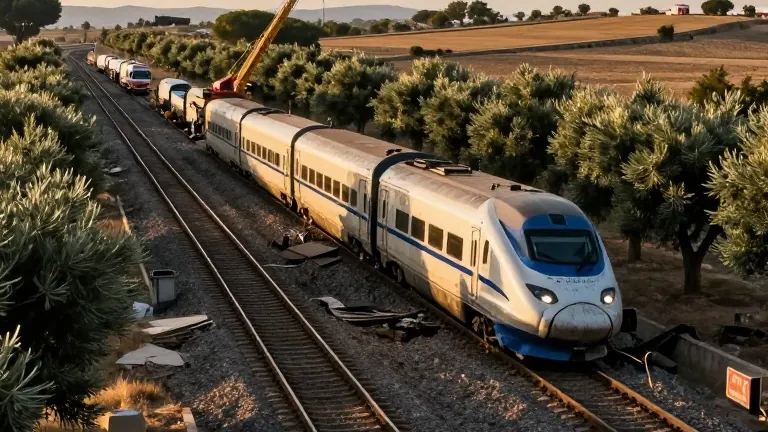
Pedro Sánchez arrived at the crash site in the central province of Toledo to oversee the response to the latest disaster on Spain's high-speed rail network. The Prime Minister visited the area after regional authorities confirmed that more than 60 people had died in the collision and that dozens of others were receiving treatment at nearby hospitals. The accident occurred Wednesday, turning a quiet stretch of track bordered by olive groves into a scene of destruction just four weeks before the national election.
The crash marked the second deadly high-speed rail incident in Spain this year. In January, 46 people lost their lives when one train derailed and struck the side of another traveling in the opposite direction in southern Spain. The country's rail network, which ranks second in track mileage globally behind only China, had not experienced a fatal crash since entering service more than 30 years ago. The system carried 45 million passengers last year, a volume that includes millions of international tourists.
Transport Minister Óscar Puente identified human error as the cause of the Wednesday collision. He explained that a computer malfunction disabled the security system on a 63-kilometer stretch of track at 8:30 a.m., forcing all trains to halt. An IRYO train stopped near the town of Urda, while a RENFE train remained 25 kilometers behind it. Minutes later, a central command center issued an order for the RENFE train to resume movement without speed restrictions. The moving train collided with the stationary IRYO train at 8:53 a.m.
Puente stated that the RENFE train should not have been authorized to move because a stop signal remained active on the line. He noted that even if movement had been permitted, the train should have been instructed to travel at a reduced speed. The minister emphasized that the train engineers were not to blame for the accident. Both fatal crashes this year involved one train operated by the state-owned RENFE and one operated by the private carrier IRYO. Spain opened its high-speed rail market to private competition in 2021, with IRYO beginning service the following year.
Sánchez declared three days of national mourning starting Thursday. He pledged a thorough investigation and improvements to the safety infrastructure to restore public confidence. "It is not acceptable for a country like Spain to endure two high-speed train accidents in the same year," Sánchez said. "It is clear that we need to reinforce the safety of our train service to rebuild the trust in our high-speed rail."
The disaster complicates Sánchez's political position ahead of the vote, which is the first national election since 2023. Polls indicate his Socialist party faces an uphill battle. Sánchez had called for early elections earlier this month, hoping to capitalize on voter dissatisfaction regarding housing costs and high rents. The new rail crisis forces his government to address safety concerns alongside right-wing criticism of his migration policies and corruption accusations against his party.
Political rivals responded quickly to the tragedy. Popular Party leader Alberto Núñez Feijóo demanded a full investigation and canceled campaign events for the day to honor the victims. "This is the moment to respect the dead, the injured and their families," Feijóo said. Santiago Abascal, the leader of the far-right Vox party, used the incident to attack the government, describing it as a criminal organization that must answer for its crimes in a courtroom.
Source: WUWF