Albanese Seeks Global Reset While Interest Rate Hike Looms at Home
The Prime Minister departs for the Commonwealth summit in Antigua and Barbuda just days before the Reserve Bank is expected to raise rates to 4.85%.
By Mia Bennett ·
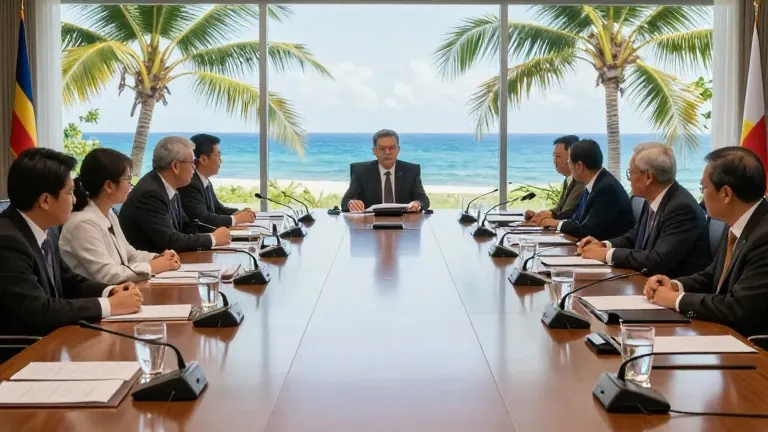
Anthony Albanese leaves for Antigua and Barbuda on Saturday to attend the Commonwealth heads of government meeting, a trip designed to reframe his political standing before a domestic interest rate decision lands on Tuesday. The Prime Minister will join King Charles III, UK Prime Minister Andy Burnham, and Canadian Prime Minister Mark Carney for the biennial summit. This gathering offers a strategic pause in a year marked by inflationary pressure and internal party friction.
Market analysts expect the Reserve Bank to increase the cash rate to 4.85% on Tuesday while Albanese is overseas. That move would mark the fifth rate hike of 2026. The timing creates a difficult scenario for the Treasurer and the Prime Minister, who must manage public frustration over rising costs of living from abroad. Dr Zareh Ghazarian, an associate professor of politics at Monash University, described the moment as strategically important for the government.
Ghazarian noted that Albanese faces many domestic challenges but views this trip as a chance to appear proactive. "He’s got a lot of spot fires burning domestically but this is going to be an opportunity for him to present himself to be much more on the front foot," Ghazarian said. The trip serves as a platform for Albanese to position himself as a peer among other global leaders rather than a domestic administrator dealing with immediate economic shocks.
Albanese emphasized the utility of the Commonwealth forum before his departure. He cited shared challenges such as climate change, ocean preservation, trade, and artificial intelligence as key discussion points. "The Commonwealth heads of government meeting is an important forum," Albanese said. "[It provides] an opportunity to work with some of our closest partners on shared challenges." This agenda aims to shift focus away from local policy disputes and toward international cooperation.
The issue of historical slavery remains a central point of contention at the summit. UK Prime Minister Andy Burnham wrote that having difficult conversations to safeguard the Commonwealth is necessary. He described the transatlantic slave trade as a "brutal and barbaric violation" of people treated as property. Burnham expressed sorrow for the suffering caused and stated that listening to calls for a formal apology is an important part of the process, though he maintained that reparations were not the right answer.
Australia’s own history with forced labor will influence the debate. During the 19th and early 20th centuries, Australian agriculture relied on "blackbirding." This practice used coercion, trickery, bribery, and kidnapping to bring more than 60,000 Pacific Islanders to work as indentured laborers, primarily on sugar and cotton plantations in Queensland. Caribbean nations have renewed their calls for Britain to apologize for its role in selling enslaved people, a topic that will likely dominate the agenda in Antigua and Barbuda.
This summit initiates a dense schedule of international engagements for Albanese. He will attend further summits in Turkey, the Philippines, China, and the United States in the coming weeks. Meanwhile, Foreign Minister Penny Wong is in Atlanta, Georgia, for the G20 foreign ministers’ meeting. The start of that conference has been complicated by the presence of Russia, with about one-third of attending countries vowing to boycott the customary group photo if Russian Foreign Minister Sergei Lavrov participates.
Source: The Guardian