Gulf oil spills cover 20,000 square kilometers since February
Satellite data reveals 500 distinct pollution events in the strait of Hormuz, threatening coral reefs and mangrove forests with decades of sediment contamination.
By Leah Thompson ·
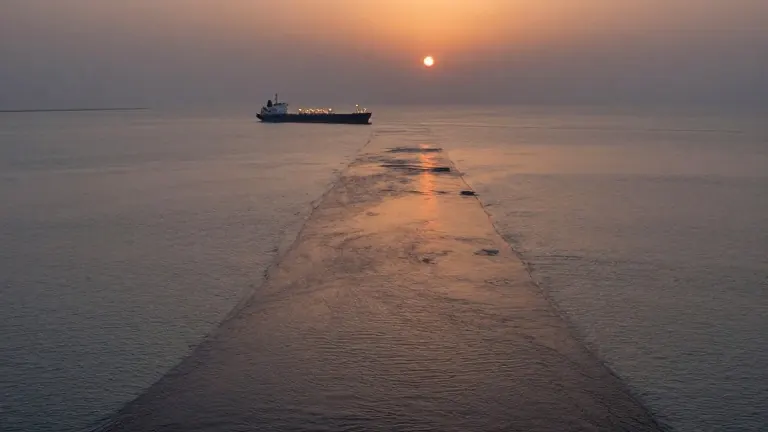
Marine biologists and environmental groups are tracking a massive accumulation of crude oil in the Persian Gulf, a region that serves as a critical chokepoint for global energy markets. The pollution has become visible from orbit as dark slicks spread across the waterway. This expansion follows eight months of conflict between the United States and Iran, which has turned one of the world's busiest shipping lanes into an active combat zone.
Greenpeace satellite monitoring has identified more than 500 separate instances of oil spills across the Gulf, the strait of Hormuz, and the Arabian Sea since the war began on 28 February. These events include large spills linked to direct vessel attacks and smaller leaks detected around the time of strikes. Nina Noelle, a Greenpeace expert on environmental disaster relief, stated that the cumulative footprint of these spills totals approximately 20,000 square kilometers. This area is nearly the size of Wales.
The frequency of attacks on shipping has increased as the conflict progresses. Greenpeace recorded more than 133 attacks on oil tankers since the start of the war. October marked the peak of this activity, with the Washington Institute for Near East Policy reporting more than 30 confirmed or reported attacks in the strait and surrounding waters. The attacks have continued into November, keeping the waterway under constant threat.
Specific incidents have produced extensive slicks that are visible in satellite imagery. A strike on the supertanker Gem No 2 off the coast of the United Arab Emirates left a patch of oil stretching more than 21 miles. Another major incident in early June involved a tanker off the coast of Oman, which produced a slick covering more than 600 square kilometers at its peak. Two Iranian naval vessels hit in March continued to leak oil for months, according to Wim Zwijnenburg, an environmental researcher with the Dutch peace organisation Pax.
The physical environment of the strait is under stress even without the war. Bernhard Riegl, a marine biologist at Nova Southeastern University, noted that the Gulf is shallow and experiences high atmospheric heat in summer. Riegl explained that this heat kills corals, algae, and fish because there is no deep cold water to buffer the temperature. He warned that the addition of oil creates a compound stress on these ecosystems.
Oil pollution has reached several key coastlines and protected areas. In March, a slick from the Shahid Bagheri was detected near the Hara mangroves. In April, pollution threatened Shidvar Island, which is home to coral reefs, seabirds, and turtles. Oil also washed ashore at Qeshm Island in August, an area known for important fishing grounds and turtle nesting sites. Satellite imagery shows slicks near Oman’s Musandam national park and Iran’s Minab River delta, both of which support rich wildlife.
Coastal states have launched cleanup operations in response to specific spills. After the attack on the Gem No 2, the United Arab Emirates closed beaches and monitored its desalination plants. Authorities on 30 October reported that the leak from that vessel had been stopped. In Oman, crews cleared oil from seven miles of coastline near the Hallaniyat Islands. However, researchers say these efforts address only the surface layer of the problem.
Long-term damage is difficult to quantify without on-the-ground investigations, which remain difficult due to the naval blockade. Some researchers in Iran and Gulf states have been instructed by domestic authorities not to speak publicly about the environmental damage. Establishing responsibility for specific spills is complex, as the Iranian Islamic Revolutionary Guard Corps is blamed for most attacks, while US forces have also targeted tankers.
The residue from crude oil can remain trapped in sediments, shorelines, and mangrove roots long after the visible slicks disappear. Noelle said that repeated spills risk worsening this damage, as mangroves and coral reefs can take decades to recover. Riegl pointed to studies from the 1980s and 1990s, which found tar deposits on Qatari beaches and contaminated sediment in Saudi Arabia decades after previous conflicts.
A 2020 study traced widespread tar deposits on Qatari beaches to the first Gulf war. A 2022 study found that sediment on Abu Ali Island in Saudi Arabia remained contaminated by oil from the 1983 and 1985 Nowruz spills, which collectively leaked 80 million gallons of crude. Riegl noted that organisms that dig into beaches, such as sea turtles laying eggs, will encounter these contaminated layers. He described the situation as a generational problem that could result in the loss of irreplaceable marine life.
More Business · Business Watchdog · Report a business · Got a Story?