SpaceX Starship upper stage targets historic pad catch
The 15th Starship flight saw the booster splash down in the Gulf, but the upper stage will attempt a first-of-its-kind return to the launch site.
By Fernando Rojas ·
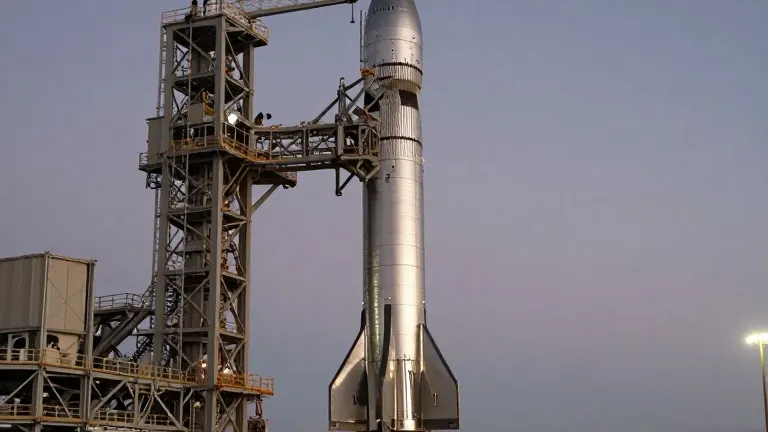
SpaceX launched its Starship rocket from the Starbase facility on the Texas Gulf Coast on Friday, initiating the 15th test flight of the program. The mission, which spans approximately 22 hours, is designed to verify the full reusability of both the Super Heavy booster and the Starship upper stage.
The 236-foot-tall first stage lifted off at 5:47 p.m. Eastern Time, carrying 8 million pounds of liquid oxygen and methane fuel. The booster, powered by 33 Raptor engines, separated from the upper stage roughly two minutes and 20 seconds after liftoff. It then flipped around to reverse course and head back to the launch site.
A technical issue prevented the booster from returning to the launch pad for capture. Flight controllers ordered a diversion to a Gulf Coast splashdown more than six minutes after launch. Long-range cameras showed the booster descending into the water, where residual propellants ignited in a fireball. SpaceX has previously caught a Super Heavy booster using mechanical arms on three prior test flights.
The 171-foot-tall Starship upper stage continued on a sub-orbital trajectory while engineers assessed its status. After an 18-minute coast, a single Raptor engine re-ignited for a 10-second burn to place the craft into orbit. The vehicle then began deploying its payload of 26 upgraded Version 3 Starlink internet satellites, with the first unit scheduled for release shortly after the orbital insertion burn.
The primary objective for the remainder of the mission is the first launch pad catch of a Starship upper stage. This maneuver is planned for Saturday, marking the first attempt to return an orbit-class rocket to the same pad for refurbishment and reuse. SpaceX describes this milestone as a critical step toward achieving a high-frequency launch cadence similar to commercial aviation.
Controllers will monitor the vehicle closely during its descent. A final return check will occur one hour before the reentry burn, which is scheduled for 3:21 p.m. Eastern Time on Saturday. A single Raptor engine will fire to lower the orbit, initiating a 56-minute belly-first reentry. The vehicle will use four control flaps to guide itself toward Starbase, weaving around the Rio Grande Valley and passing north of South Padre Island.
Upon nearing the pad, the Starship will fire three Raptor engines to flip upright. It will then descend between the gantry's mechanical arms, slowing to a near stop with one engine before the arms secure the spacecraft. If any systems encounter issues during reentry, controllers can tumble the vehicle to ensure it breaks up in the atmosphere or divert it to the Gulf, avoiding populated areas in northern Mexico and southern Texas.
NASA relies on a Starship variant to carry Artemis astronauts to the Moon in 2028. The space agency is currently evaluating Blue Origin's Blue Moon Mark 2 lander as an alternative, depending on which vehicle is ready for operation. The outcome of this weekend's catch will inform the timeline for both commercial and government missions using the rocket.