Ukraine and Russia push to build military satellite networks as war grinds on
Kyiv has launched its first nanosatellite and enlisted European partners to reduce its dependence on Elon Musk's Starlink, while Moscow's rival constellation struggles with failing hardware.
By News Media House Staff ·
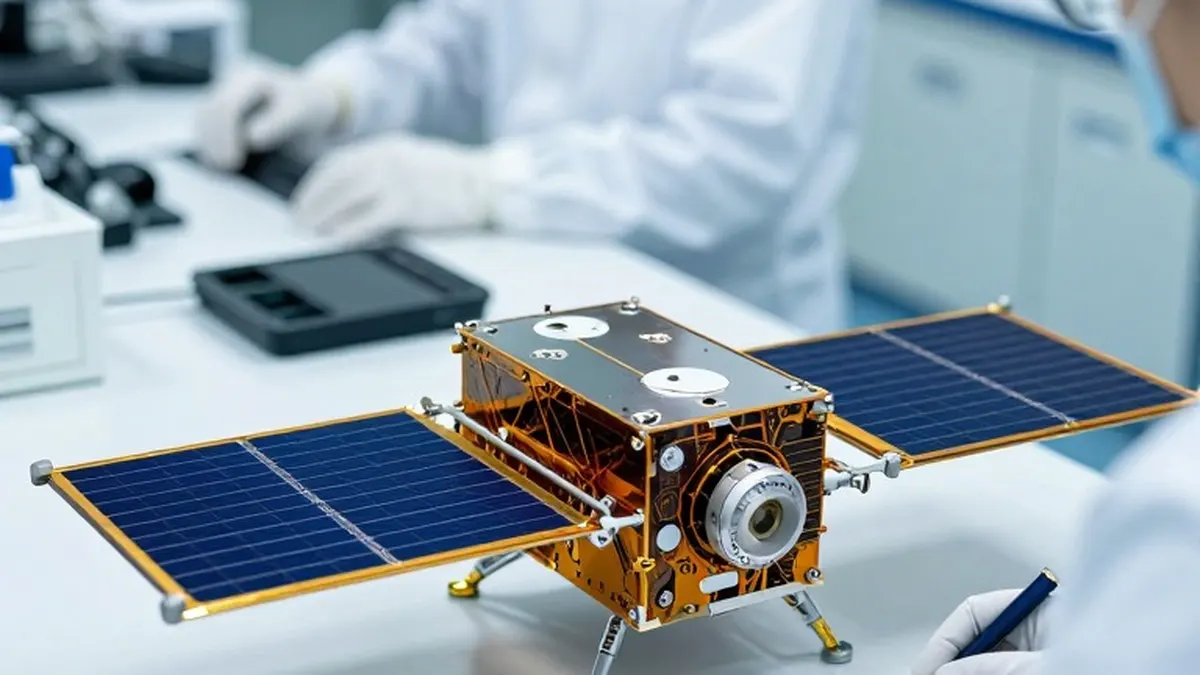
Ukraine has taken its first step toward an independent military satellite network with the launch of the Obria Nano, a small spacecraft resembling a desktop tower with wing-like solar panels. The nanosatellite was developed by Himera, a Ukrainian firm known for ergonomic military radios, together with GomSpace, a Danish small-satellite manufacturer.
Himera described the launch on October 27, nearly four weeks after the satellite reached orbit, as Ukraine's "first historical step toward establishing resilient and sovereign satellite communications capabilities." In mid-October, Kyiv also signed up two Finnish companies, telecoms giant Nokia and space startup ICEYE, whose radar technology can capture high-resolution imagery in any weather, to explore building a military satellite network.
The drive stems from Ukraine's near-total reliance on Starlink, the SpaceX constellation of more than 10,000 low-orbit satellites. On Thursday, speeds on Starlink and Starshield, its Pentagon-operated military component, were limited for Ukraine, causing what President Volodymyr Zelenskyy called "significant disruptions" along the front line, following an earlier disruption last month.
Kyiv accepts that replacing the system will not happen quickly. "It's possible to create an absolutely new system, but it will take several years," US-based space expert Anatoly Zak told Al Jazeera. "In the nearest year or two, Starlink and [its military-grade component] Starshield are absolutely necessary."
Ukraine's relationship with Musk has swung between gratitude and frustration since 2022. His free provision of Starlink services and modems made the network the communications backbone for the military, hospitals and critical infrastructure, but in late 2022 he refused to activate coverage in Russian-occupied areas, hindering a Ukrainian counteroffensive. He has also said Kyiv should remain "politically neutral," cede Crimea and accept UN-supervised referendums in occupied territories. Russia, meanwhile, reportedly smuggled thousands of Starlink terminals for communications and drone attacks until February, when Musk restricted service to certified modems.
Kyiv's search for alternatives accelerated after Starlink and Starshield imposed speed limits on Ukrainian drones without warning between October 14 and 24, cutting signal to drones and interceptors travelling faster than 60 kilometres per hour. Musk initially blamed the Pentagon, then admitted the decision was his after The Wall Street Journal reported he had personally authorised the slowdown. "Musk's mood swings play a significant role," said Volodymyr Fesenko, head of the Kyiv-based Penta think tank, noting that SpaceX accounts for two-fifths of Musk's net worth. "If he tries to throw Ukraine under the bus, it may work as very negative advertising for his business, including the Starlink system."
Russia is pursuing its own version of Starlink, and President Vladimir Putin has added flattery to the effort, calling Musk a "real genius" on October 28. Putin said Moscow was "in close contact with our American partners, including Mr Musk," citing the need for order in orbit. The results so far have been poor: the Rassvet (Dawn) constellation, run by Kremlin-controlled Bureau 1440 and planned to reach 900 satellites by 2035, relies on Chinese-made Qianfan satellites. The Institute for the Study of War said in August that more than a third of Rassvet satellites failed to reach "sustainable operational altitudes," and by early November two of the 32 Rassvet 3 satellites launched in the past seven months had been lost, including one that burned up on November 1 after its propulsion failed, according to Ukraine's Defence Express publication.
Kyiv could also turn to Starlink's rivals, though they are smaller and less capable. US-based Iridium operates 66 satellites at about 800 kilometres altitude, while Eutelsat's OneWeb has up to 650 satellites at 1,200 kilometres but is not authorised for military drone strikes. A typical terminal in Ukraine sees about 60 Starlink satellites at once but only 11 OneWeb satellites, and a compact Starlink terminal costs up to $500 compared with $9,000 for a bulkier OneWeb unit.
Pavel Luzin, an analyst with the Jamestown Foundation in Washington, said Kyiv has two paths: costly geosynchronous satellites that could serve for up to 20 years, or hundreds of cheaper low-orbit satellites that require constant replacement. Cheaper options include stratospheric drones acting as "quasi-satellites," AI-guided drones that need no satellite link, and ballistic missiles. "I don't rule out that Ukraine won't have to create any alternatives, because SpaceX is definitely interested, even if someone in the company doesn't realise that, in Ukraine using it further," he said.
Originally published by News Media House