Iranian Bases: Satellite Data Shows New Excavations Near Missile Sites
Analysts say digging at Garmdareh and Shahroud suggests Tehran is moving infrastructure underground to withstand future strikes.
By Leah Thompson ·
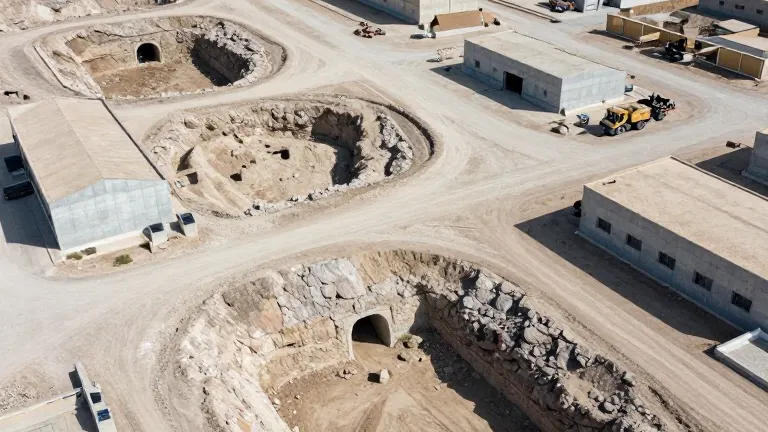
Following months of intense aerial bombardment by the United States and Israel, new satellite imagery reveals substantial construction activity at key Iranian military locations. The visual evidence points to a strategic shift in how Tehran protects its assets from future attacks.
Images captured in November show digging and the erection of new structures at the Garmdareh military base in Karaj, located near Tehran. Similar activity is visible at the Shahroud base in the north. Analysts at the British intelligence firm MAIAR, who reviewed the photographs for BBC Verify, identified these changes. They noted that at least 12 other military sites, including missile complexes and air bases, display signs of repair work.
At the Kermanshah missile base in western Iran, near the border with Iraq, new roofs have been installed on buildings that were previously destroyed. At the Parchin military complex east of the capital, crews have cleared debris and damaged buildings. The Parchin site has been targeted repeatedly in the current conflict and in previous engagements.
Jim Lamson, a former CIA analyst who specialized in Iran, suggested the excavations near Shahroud could be linked to missile production. He explained that because the nearby air base has been hit multiple times in recent years, the Islamic Revolutionary Guards Corps is likely attempting to move production facilities underground. A MAIAR analyst observed that Iran has a history of moving infrastructure underground to protect it from further strikes.
Mark Mellett, a defence analyst and former head of the Irish military, added that underground facilities make it harder for outside observers to assess the extent and operational status of Iranian military capabilities. Sam Lair, a research analyst at the Foreign Policy Research Institute, stated that images from Karaj appear to show a new portal for an underground facility. He also noted that multiple vehicles were visible in the satellite images of the area.
Sean O'Connor, an analyst with the intelligence firm Janes, argued that the construction work is unlikely to be an effort to deceive foreign intelligence agencies. He described such a project as costly and potentially achieving little in terms of deception. The developments occur after the White House repeatedly assured the public that US-Israeli attacks have depleted the Iranian armed forces.
US President Donald Trump recently described the Iranian military as a complete and total mess. A Pentagon spokesperson previously claimed that the US destroyed up to 90 percent of Iran's drone, ballistic missile, and naval industrial base. Iran disputes these figures, claiming it retains large stockpiles of missiles. State television broadcast footage this week showing dozens of missiles at the entrance to an underground facility in southern Iran.
Activity related to military assets indicates that Tehran is bracing itself for further attacks, according to Mark Cancian, a military analyst with the Center for Strategic and International Studies. He stated that the purpose is to better defend against future attacks and to prioritize rebuilding military capability over rehabilitating the economy.