NASA Faces Launch Gap As SpaceX Shifts Focus From Falcon 9
SpaceX is testing Starship today while planning to retire the Falcon 9 rocket, leaving the space agency with limited options for astronaut transport beyond 2028.
By Fernando Rojas ·
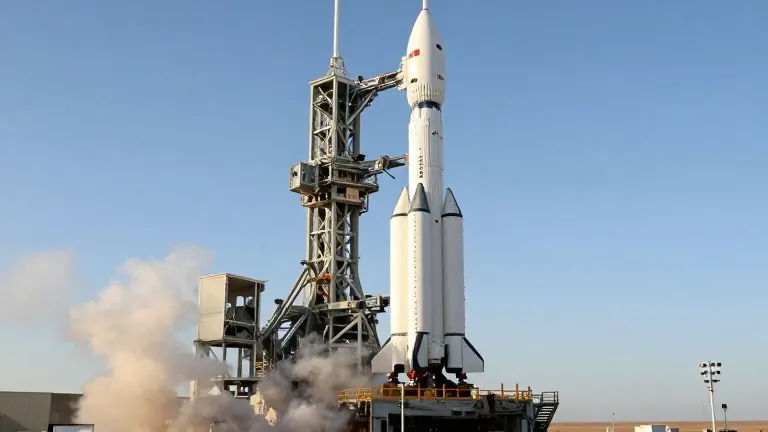
SpaceX will attempt its most ambitious Starship test later today from South Texas.
The rocket is designed to circle the Earth and land vertically on the same pad 22 and a half hours after liftoff.
Success would mark a key step for the vehicle that Elon Musk hopes will eventually carry humans to Mars.
However, the rapid development of Starship creates a new problem for NASA.
SpaceX has indicated it will stop flying the smaller Falcon 9 rocket to free up engineering resources for Starship.
The Falcon 9 currently launches the Dragon capsule, which is the only American spacecraft that ferries NASA astronauts to the International Space Station.
Caleb Henry, director of research at Quilty Space, noted that Dragon became the de facto way for astronauts to reach orbit due to its reliability.
NASA contracted with SpaceX in September for three additional station flights.
These missions would extend Dragon service only through 2028 if flown consecutively every six months.
The space station is scheduled to retire in 2030.
This situation reverses a past dynamic where SpaceX relied heavily on NASA for survival.
In 2008, SpaceX was nearly bankrupt after multiple Falcon 9 failures, according to Musk, who said the company had virtually no money at the time, and told CBS 60 Minutes in a 2014 interview that he blurted out 'I love you guys' when NASA awarded a large contract just before Christmas, and for the next decade, steady NASA and Pentagon contracts provided a major share of the company's revenue, but that changed in 2020 when SpaceX launched its Starlink satellite internet service, which quickly generated more revenue than rocket launches, as SpaceX's latest financial report shows the company made about $2.1 billion from space launches through September this year, while Starlink earned roughly $12.8 billion and its AI business brought in about $10.9 billion, and Starship is central to these newer businesses, with Musk stating on X earlier this year that shifting resources to Starship means winding down Falcon, and SpaceX president Gwynne Shotwell compared the Falcon 9 and Dragon capsule to a minivan, saying it is not suitable for the six-month road trip to Mars, but the minivan is the only current American option for short station trips, and Henry said building new capsules is expensive and time-consuming, with NASA being the only major customer willing to pay, and a Quilty Space analysis found the commercial market may face a shortage of 150 launches by 2030, leaving the Pentagon scrambling for rides for national security satellites, though the U.S. Space Force said in a statement to NPR that it has secured Falcon 9 launches through 2028 and is confident other suppliers will fill the gap, and Tim Farrar, president of TMF associates, said SpaceX has grown beyond its launch business and does not make significant money from NASA missions, which he described as small potatoes, and Shotwell implied at a September summit in Los Angeles that Boeing could fly to the station instead, noting that Boeing has been paid more than SpaceX to develop its human capsule, and the Boeing Starliner suffered a nine-month stay on the station in 2024 after its first crewed test failed, with the astronauts returning in March 2025 on a SpaceX vehicle, and a next Starliner test flight is set for this winter with a crewed flight planned for 2028, and Farrar said one would hope for a bit of loyalty given NASA's role in keeping SpaceX alive, but it is not yet clear when SpaceX will officially retire the Falcon 9, as the company did not respond to a request for comment.