Jordan Valley Fences Cut Off Herders From Grazing Land
Local residents report rising feed costs and limited access as questions arise over who built the barriers and when.
By Fernando Rojas ·
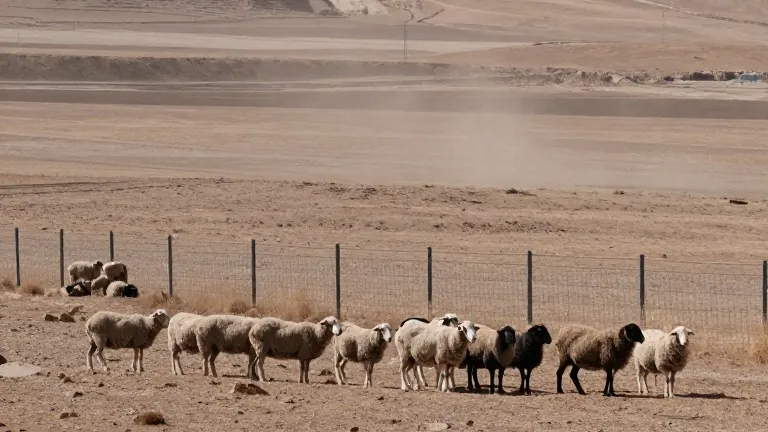
Barriers spanning the Jordan Valley have restricted Palestinian shepherds' access to traditional grazing areas, forcing many to buy expensive feed to sustain their livestock.
The conflict over the fencing began in November 2025 when Mohammad, a resident of al-Hadidiya, a community of 60 people, discovered workers constructing a barrier on his property. He stated that the workers told him to leave. The fence stretches for several kilometers, separating residents from grazing land without fully enclosing their homes. In nearby Khirbet Samra, another resident with 400 sheep reported that his barley purchases increased from two annual truckloads to one every two months. Each 20-ton load costs at least 20,000 new Israeli shekels.
Dr. Dror Etkes of Kerem Navot mapped the barriers and estimated that approximately 60 kilometers of fencing block access to hundreds of thousands of dunams. He noted that most fences appeared between the summers of 2025 and 2026, though some were older. The Israel Defense Forces stated that the barriers mark military firing zones to prevent injuries from unexploded ordnance. The Defense Ministry's Civil Administration described the construction as a military operation. Etkes countered that the fences only partly overlap with designated zones and that some are located far from them.
Visual evidence shows people in civilian clothing building the fences, including minors. Some builders wore shirts with the logo of the Artzenu organization, which supports settlement efforts. The organization did not respond to inquiries about its involvement. Palestinians and activists suspect settlers built the fences to expand land control. The military said the discrepancy remains under review.
The United Nations Office for the Coordination of Humanitarian Affairs reported that more than 2,000 people were displaced in the Jordan Valley between January 2023 and July 2026 due to settler violence and access restrictions. Eleven communities were completely displaced, including five in 2026.
In August 2025, residents near Farsiya challenged a fence in the High Court. The state acknowledged the construction was unauthorized. Lawyer Tawfiq Jabarin said removal occurred only after further court intervention. Residents reported the military dismantled the fence on October 13, 2026. A separate petition involved fencing near Ein al-Hilweh on private land owned by the Latin Patriarchate. The state promised removal by October 28 after acknowledging the land ownership. Activists reported that only part of the fence was dismantled on October 23, with the remainder still standing.