Sudanese Army Advances in Kordofan Shift Strategic Balance Against RSF
Sudanese Armed Forces capture key towns in Kordofan, shifting the strategic balance of the war against the Rapid Support Forces and threatening the paramilitary group's supply lines and tribal alliances.
By News Media House Staff ·
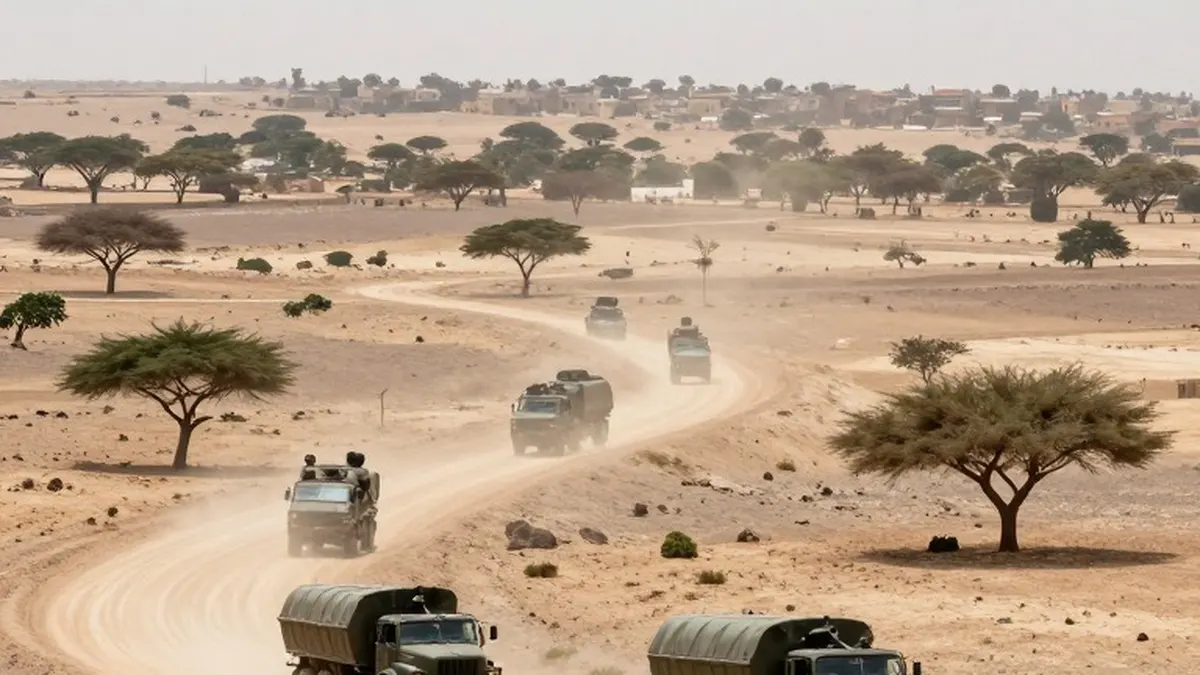
The Sudanese Armed Forces have secured control of several key localities in West Kordofan, marking a significant shift in the ongoing war against the Rapid Support Forces. On Friday, the army announced it had taken al-Khuwai, a major town and strategic site in the resource-rich state. This capture is part of a broader offensive that has successfully broken the RSF siege on al-Obeid, the capital of North Kordofan, and opened new military routes through central and southwest Sudan.
These gains pave the way for further advances toward Babnusa and the approaches to North Darfur. A critical road linking al-Nuhud, a site for gold mines, to al-Khuwai is now within the army's operational reach. While the RSF and its alleged allies, including the Sudan People's Liberation Movement-North, still hold al-Nuhud and parts of South Kordofan, recent defeats may weaken the paramilitary group's ability to maintain local support in the region.
Analysts suggest that the RSF's shift from an aggressive posture to a defensive one could alter its military composition, which has traditionally relied on rapid tribal mobilization. Mohamed Ali, an independent Sudanese analyst, noted that Kordofan is not a social stronghold for the RSF. He expects the group to withdraw and reposition its forces in Darfur, potentially making that region the new epicenter of the conflict sooner than anticipated.
The RSF has historically depended on Arab communities in south and east Darfur for support. Mohiedeen Mohamed, a military affairs expert, explained that this reliance on informal tribal coalitions makes the group vulnerable to changing war conditions. As the army gains ground, several tribal groups have defected in recent weeks. These alliances in Kordofan were often driven by military necessity rather than deep historical integration, according to Mohamed.
The conflict, which escalated into a nationwide war in April 2023 following a power struggle between SAF and RSF leaders, has created one of the world's worst humanitarian crises. Approximately 150,000 people have been killed, and more than 14 million of Sudan's 53 million residents have been displaced. Fighting has increasingly focused on the oil-rich and strategically important provinces of Darfur and Kordofan, where battles over geography and supply routes are intensifying.
The United Nations has identified Kordofan as the current epicenter of the conflict, noting that fighting there is complicating an already dire humanitarian situation. About 4.5 million civilians have fled to neighboring countries such as Chad, Egypt, and South Sudan. In October alone, drone attacks in western regions killed around 160 people, with both sides accused of using drones to target civilian infrastructure and disrupt daily life.
Despite the challenges, the SAF's growing air superiority and changing ground tactics have enabled unexpected advances. Al-Rasheed Mohamed, a military expert, stated that the army is now taking the initiative across various fronts while the RSF is pushed into a defensive position. The consolidation of gains in central Sudan opens a new route toward Darfur, supporting the army's broader strategy to reclaim control of the country.
Control over Kordofan offers substantial economic benefits, as the region is rich in agricultural products like sesame seeds and gum arabic. It is also home to the Heglig oilfield, a major hub for processing and transiting crude oil for both Sudan and South Sudan. Professor Mohamed al-Nayer of the University of Sudan emphasized that restoring state control is a critical economic priority that would allow the government to regain control of natural resources and revive exports.
The Heglig and Balila oil fields in West Kordofan produce 90% of Sudan's oil. Securing these sites would reduce Sudan's dependence on imported petroleum and strengthen public revenues. Additionally, Kordofan's proximity to South Sudan grants control over key border crossings and trade routes. Al-Nayer noted that both nations share a strategic interest in securing oil infrastructure and restoring cross-border trade, as South Sudan's oil exports rely on transportation through Sudanese territory to Bashayer Port.
Originally published by News Media House