Two Artists Turn War and Exile into Memory in Beirut Studios
Palestinian sculptor Abdul Rahman Katanani and Lebanese painter Ayman Baalbaki use distinct artistic practices to confront the history of violence and displacement in the region.
By News Media House Staff ·
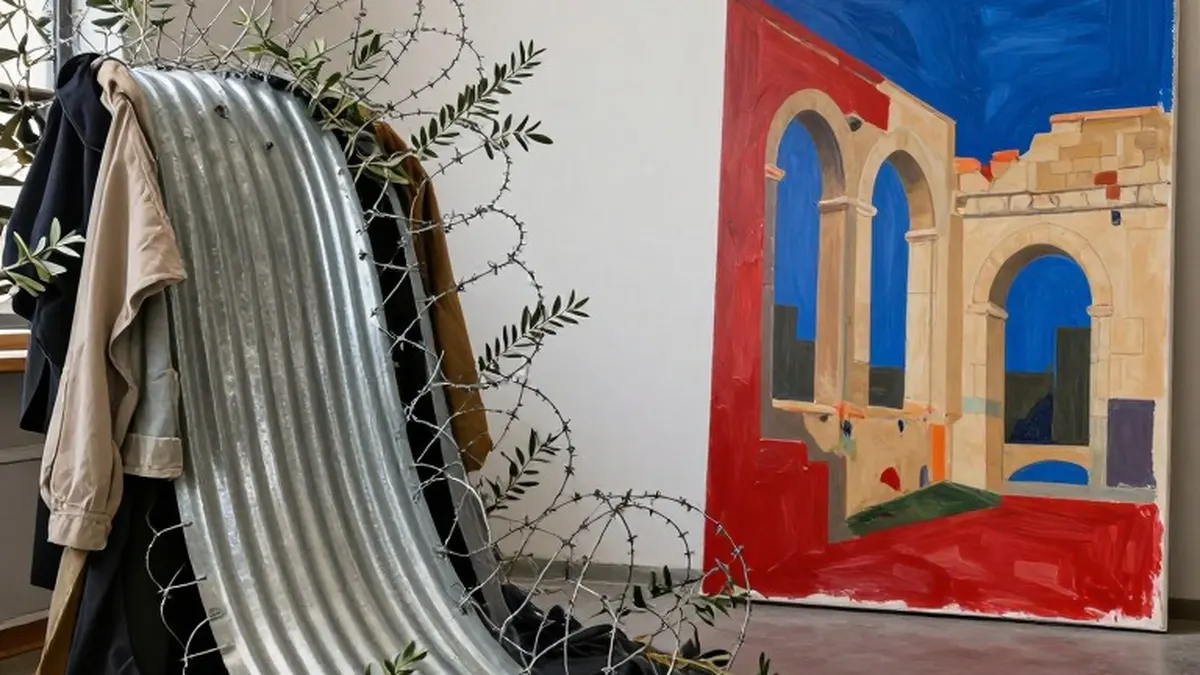
In two separate studios in Lebanon, artists Abdul Rahman Katanani and Ayman Baalbaki create works that address the themes of memory, destruction, and survival. Their spaces, one located in a busy part of central Beirut and the other in a village high in the hills, serve as centers for their artistic expressions. These environments reflect the personal and collective histories of their families, shaped significantly by the Israeli wars that impacted their youth.
Katanani, a Palestinian sculptor, works with materials sourced from the Sabra and Shatila refugee camp where he was born. His pieces incorporate barbed wire, corrugated metal, olive branches, and discarded clothing. He describes these items as the shadows of the camp, or the camp itself. His creations range from a nine meter wave made of barbed wire to intimate collages of clothes, including underwear. In one notable project, he constructed a replica of his childhood camp for display in an art gallery.
Baalbaki, a Lebanese painter, is known for large scale mixed media works featuring thick layers of acrylic paint in vivid and subtle colors. His series Destruction and Loss depicts the ruins of Beirut, including the Barakat Building. This historic structure, once a center of Ottoman style grandeur, was damaged during the civil war and now serves as the Museum of Memory. Another series, Al-Mulatham, features veiled men in red keffiyehs against backgrounds of bright floral fabric, referencing rural southern Lebanon.
The two men have been close friends for over a decade, a bond formed while working with the same gallery. Their work shares recurring themes that mirror the region's history of conflict, including Israel's attacks on Lebanon, the occupation of the south, the civil war, and the Syrian military presence. Baalbaki comes from a prominent artistic family in the southern village of Odaisseh. His grandfather's home was destroyed during Israeli operations, and his father, Fawzi Baalbaki, was among those listed as leftists or pro Palestinian figures by Israeli forces in 1979.
Baalbaki spent the civil war years in Wadi Abu Jamil, a contested area in Beirut, where he lived between ruined buildings. He recalls seeing erasure and young people kidnapped during that period. Many of his father's paintings were destroyed or stolen during the Israeli occupation. Ayman Baalbaki later studied in Paris at elite art colleges, following in his father's footsteps. He credits a trip to Mexico and the influence of Diego Rivera's open mindedness for changing his vision of the world.
Katanani was born eight days after the 1982 massacre at Sabra and Shatila, where at least 2,000 civilians were killed. He grew up in a room in the damaged Gaza Hospital within the camp. As a boy, he worked as a porter for his carpenter father and drew caricatures for residents. He entered the Fine Arts College at age 14 or 15 after a friend's recommendation and a scholarship. He describes the camp as a place that bred a psychological sense of isolation, where residents knew little of the outside world.
Katanani's international career began when French delegates saw his murals in the camp. His work was subsequently shown in universities in France and Spain, and at a graffiti festival in France in 2005. A French passport allowed him to take up residencies abroad, where he met pro Palestinian artists that influenced his perspective. He spent 15 months at the Cite Internationale des Arts in Paris, using the experience to question his identity as an artist and his contribution to society.
Both artists were in Egypt on October 7, 2023, when the war began. They felt paralyzed by the events and rushed back to their homes. Katanani lost 15 family members in Gaza and entered a deep depression. Baalbaki describes work as a form of resistance against that paralysis. Their pieces are currently displayed in museums, private collections, and international art fairs.
The two men remain deeply connected to their families. Katanani lives in his studio with his mother, an expert embroiderer, his twin brothers, their daughters, and two cats. Baalbaki's father, Fawzi, has described his son as a guardian angel who plays a major role in his current work. Ayman jokes that his father chooses his art to escape into joy, contrasting with his own generation's perspective.
Rose Issa, a Lebanese French curator who has known both artists for years, describes them as exceptional individuals with generous minds and hearts. She states that their work is stunning and unforgettable, capturing the essence of their shared history and personal struggles.
Originally published by News Media House