A physicist predicted humanity's end on November 13, 2026. The math has not held up.
A 1960 paper by physicist Heinz von Foerster forecast that overpopulation would reach a breaking point on this very date, a prediction that scholars dismissed then and that history has largely defied.
By News Media House Staff ·
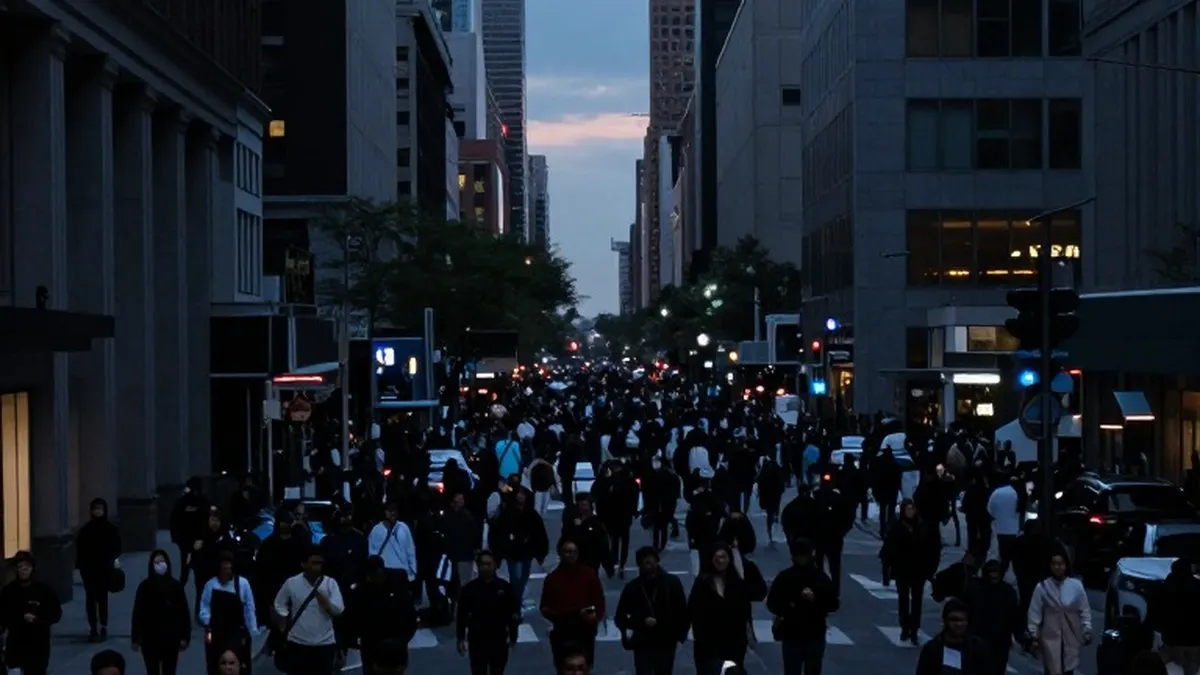
A global Microsoft outage left millions of users cut off from Outlook and other essential tools this week, and the company was still working to restore full service on Friday morning. It is hardly an apocalypse, but the timing carries a strange echo: November 13, 2026, falling on a Friday no less, is the exact date a physicist once predicted humanity would reach its end.
The physicist was Heinz von Foerster, who laid out his forecast in a 1960 paper published in the journal Science. His analysis concluded that by this date, overpopulation would push past its breaking point.
Von Foerster was not the first to sound such an alarm. Back in 1798, English economist Thomas Malthus, one of the early pioneers in modeling population dynamics, warned that a rapidly expanding population would eventually outstrip the available food supply and humanity would starve. His model assumed exponential growth, but that equation holds only under specific conditions, such as bacteria growing in a perfectly controlled laboratory environment. Even in those cases, growth proceeds exponentially only for a while; it does not continue indefinitely.
Population dynamics are famously difficult to calculate, because the system involves an enormous number of variables and a great deal of unpredictability. In his 1960 analysis, von Foerster measured past population growth trends accurately, but, like Malthus, he assumed those trends would extend into the future essentially unchanged. That led him to project that human population growth would march inexorably toward infinity.
Notably, von Foerster did not believe people would starve. He thought humanity would be ingenious enough to solve the food supply problem. The danger, as he saw it, was sheer crowding. "They will be squeezed to death," he wrote.
His conclusion drew sharp criticism from the start. Plenty of scholars at the time rejected the prediction outright, calling it "ridiculous" and "manifestly absurd."
Reality soon sided with the critics. Global population growth did not keep accelerating at an exponential rate, and the baby boom tapered off only a few years after von Foerster's paper appeared.
"He got the picture right just as that picture ceased to be right," mathematical biologist Joel Cohen of Rockefeller University and Columbia University recently told Popular Science. "The all-time peak happened in the early 1960s."
Von Foerster's projection also failed to account for other forces reshaping demographics, including longer life expectancy and the sharp decline in child mortality rates. Those shifts, combined with slowing growth, meant the date circled in his paper would arrive without the catastrophe he imagined. Friday the 13th, it turns out, has brought a software outage rather than the end of the world.
Originally published by News Media House
More News · National news · Report a business · Got a Story?