Aly Muritiba Says Centering Black Joy in Brazilian Musical Funk Is Revolutionary
The Brazilian director discusses his competition entry at the Huelva Ibero-American Film Festival, a musical led by rising star Duda Santos that celebrates favela life and funk culture without prejudice.
By News Media House Staff ·
At first glance, Funk might look like a sharp departure for Aly Muritiba, arriving after the Venice-selected Private Desert and the Gramado closer Drenched in Blood. The Brazilian director, however, sees a clear thread connecting all three films and much of his earlier work: a curiosity about loneliness and desire. In Funk, that curiosity shapes the story of a young woman determined to become a Brazilian funk star, even as her climb toward fame demands heavy personal sacrifice.
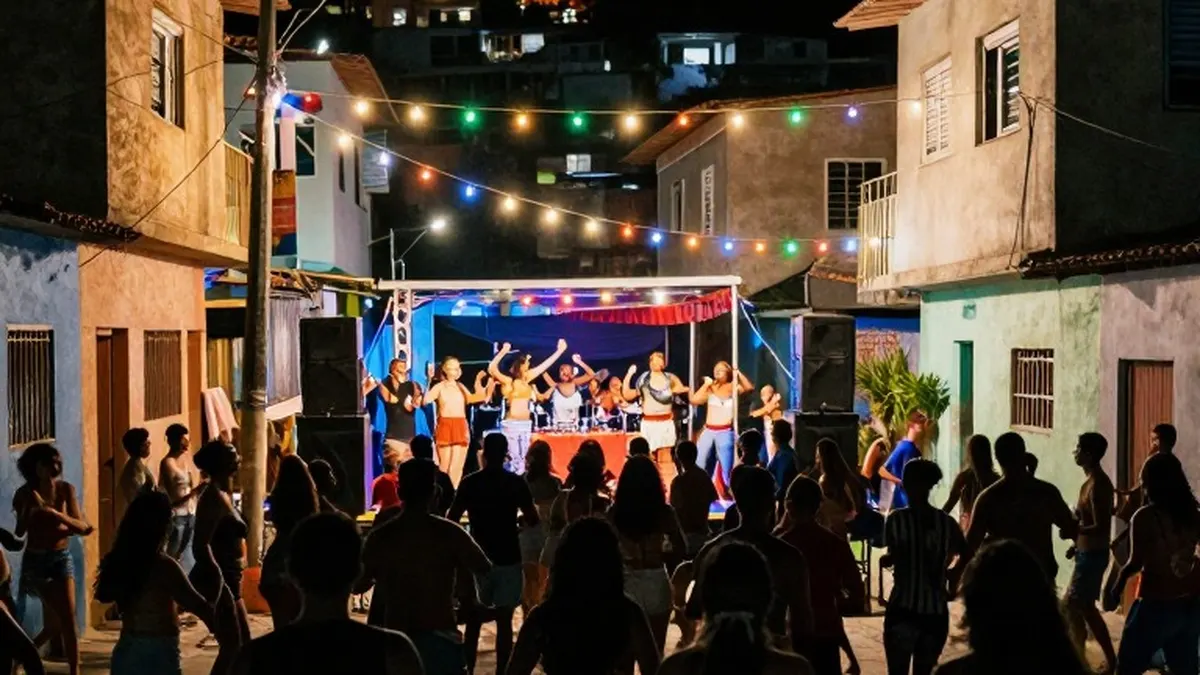
The film is playing in competition at the Huelva Ibero-American Film Festival after premiering at Tribeca. It opens with a jolt of energy at a party in a Rio de Janeiro favela, where Sabrina, played by Duda Santos, feels most alive. On stage she slips into her MC persona, singing about explicit sexual desire over the bass-heavy beats of funk, the Brazilian rhythm that has drawn international admirers including Madonna and The Weeknd. Sabrina is described as a rocket: ambitious, unapologetic, and clear-eyed about both her professional and sexual desires.
Speaking with Variety ahead of Huelva, Muritiba said the idea of speaking about the favela from a different perspective originated with producers Heitor Dhalia and Manoel Rangel, who had shot series in Rio's favelas and witnessed what they called the potency of funk. They invited Muritiba aboard, and the trio developed the character of Sabrina together. The director described his research as empirical, attending numerous funk parties across Rio while shaping the script and the film's visual identity.
Casting followed, overseen by Alonso Zerbinato, who Muritiba said cast directly from the favelas and funk parties of Rio. The large ensemble includes several real-life funk singers, among them Lelle and MC Nem. For the lead, however, the director felt he needed a seasoned performer. "The majority of the ensemble consists of real-life funk singers, but I needed an experienced actress for the main role because Sabrina is a very complex character," he said.
The role went to Duda Santos, whose profile has surged over the past two years through leading parts in hit telenovelas such as Garota do Momento and A Nobreza do Amor. "Duda is a great actress, but also a great dancer," Muritiba noted, adding that after several television roles she was eager for her first film part and embraced the opportunity. He praised her discipline, saying she spent hours each day on preparation, including singing, dancing, and stage presence lessons on top of long rehearsals. "It's very gratifying to see such a young actress be this talented and committed to her craft," he said.
Despite breaking out internationally and being adopted by English and Spanish-language performers, Brazilian funk has long carried a stigma tied to its sexual content and its roots in lower-class favelas. Muritiba pointed to a contradiction in which Latin American art gains value when recycled by Americans and Europeans while homegrown artists are ignored. He chose to confront those stigmas, he said, without prejudice and conservatism. "In the context of the favela, to talk about sex or have sex is to celebrate life and freedom," he added, arguing that portraying Black bodies living, loving, and feeling pleasure is revolutionary in a country shaped by more than 300 years of slavery and where large numbers of Black people are killed every day.
Muritiba also noted that Brazil has produced internationally celebrated favela films such as City of God and Elite Squad, but said that subgenre tends to frame Black characters through relentless suffering. "What 'Funk' proposes is the very opposite: Black people happy, alive, and vibrant. We don't have a single gunshot in the film. This is revolutionary," he said.
Music was central to the production. The film features entirely original songs, composed by Ambulantes in partnership with DJ Renan Valle. "It was a very rich process creating the songs from the ground up," the director said, explaining that choosing beats and writing lyrics helped shape the movie's rhythm. Filming in the favelas brought both difficulty and reward. "Going up and down hills, stairs, little streets and seeing the poverty faced by so many Brazilians was very difficult, but it was also beautiful to experience a latent sense of community amongst the locals, something that contaminated the film."
While Muritiba remains pleased to bring Funk to festival audiences, his focus has shifted to his next project, New Eden. Starring Welket Bungue, Gabriela Pousa, and Zahy Tentehar, the folk horror follows Damiao, a young Black priest who arrives in a village in Southern Brazil. The director says only that the film will premiere next year at a major international festival.
Originally published by News Media House
More News · National news · Report a business · Got a Story?